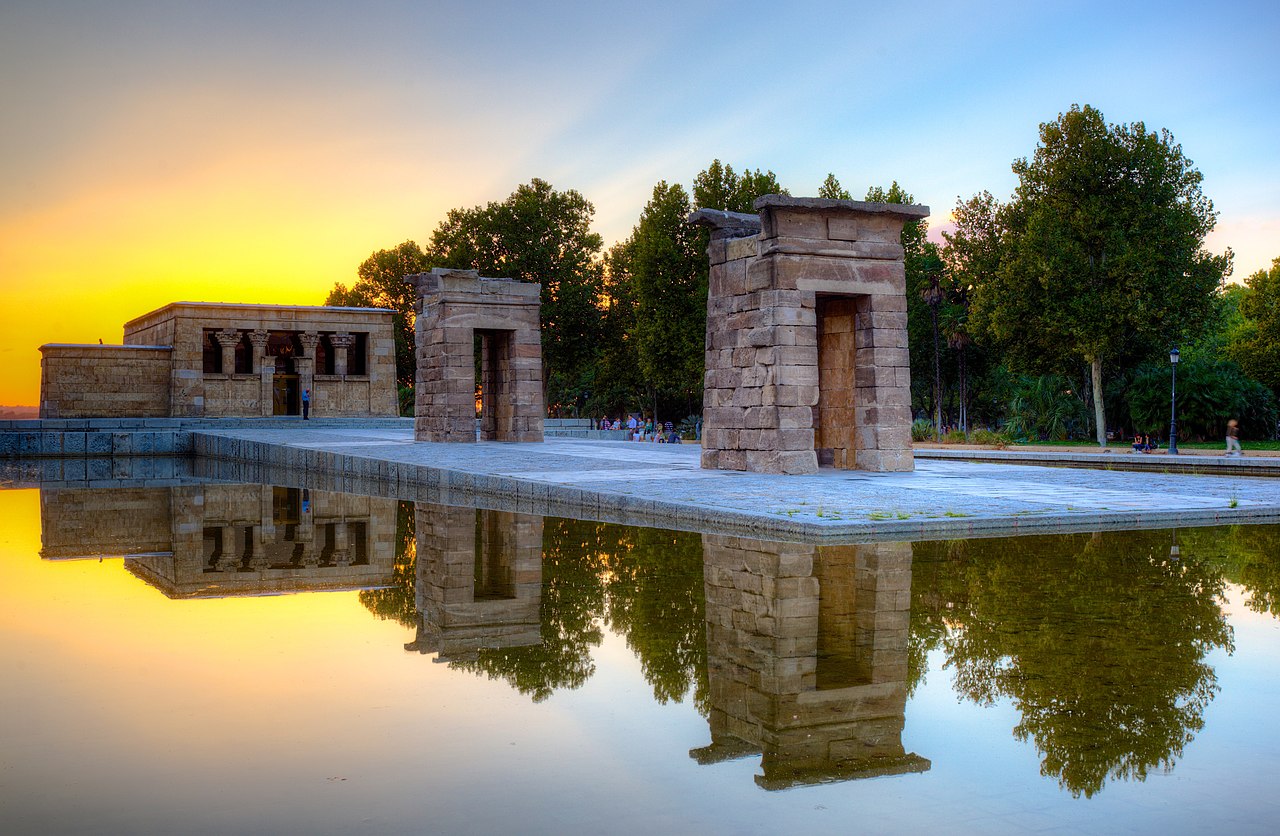
Temple of Debod
Historical Significance
The Temple of Debod dates back to the early 2nd century BC, when the Meroitic King Adikhalamani began its construction in the Nile Valley. Originally dedicated to the god Amun of Debod and the goddess Isis of Philae, the small single-room chapel served as a significant religious site for the local population. Its location near the First Cataract of the Nile made it a spiritual gateway for travelers and pilgrims moving through the region. Over the subsequent centuries, the temple underwent several expansions. During the Ptolemaic dynasty, additional rooms were added around the original core, and later, Roman emperors including Augustus and Tiberius contributed to its decoration and structural integrity. The temple remained a site of worship until the 6th century AD, when the rise of Christianity led to the closure of pagan temples throughout the Roman Empire, leaving the structure to face the elements and the rising tides of history. The most dramatic chapter of its history occurred in the 20th century. Due to the construction of the Aswan High Dam, the temple was threatened by flooding. In response to an international appeal by UNESCO to save Nubian monuments, the Egyptian state donated the temple to Spain in 1968 as a gesture of gratitude for Spanish assistance in saving the Abu Simbel temples. It was dismantled stone by stone, shipped to Valencia, and eventually reconstructed in Madrid's Cuartel de la Montana Park, where it was inaugurated in 1972.
Did you know?
"The Temple of Debod is one of only four ancient Egyptian temples located outside of Egypt, and it is the only one of its kind in Spain."
Tour Guide Narration
Visitor Tips
- 1Visit during sunset for the most iconic views and photography opportunities.
- 2Entry to the interior is free, but wait times can be long due to strict capacity limits.
- 3The temple is located in a public park, making it an excellent spot for a picnic.
- 4The interior may be closed during extreme weather to preserve the ancient stone.
Nearby Attractions
Royal Palace of Madrid
The largest functioning royal palace in Europe, located just a 10-minute walk away.
Almudena Cathedral
A grand Catholic cathedral known for its colorful modern interior and neo-Gothic exterior.
Plaza de Espana
A massive square featuring the famous monument to Miguel de Cervantes and his characters Don Quixote and Sancho Panza.
Experience UrGuidr
UrGuidr uses advanced AI to identify landmarks and narrate their history in real-time. Join thousands of explorers worldwide.
Start Your Journey